Mastercard Chargeback Reason Code 4853: Cardholder Dispute
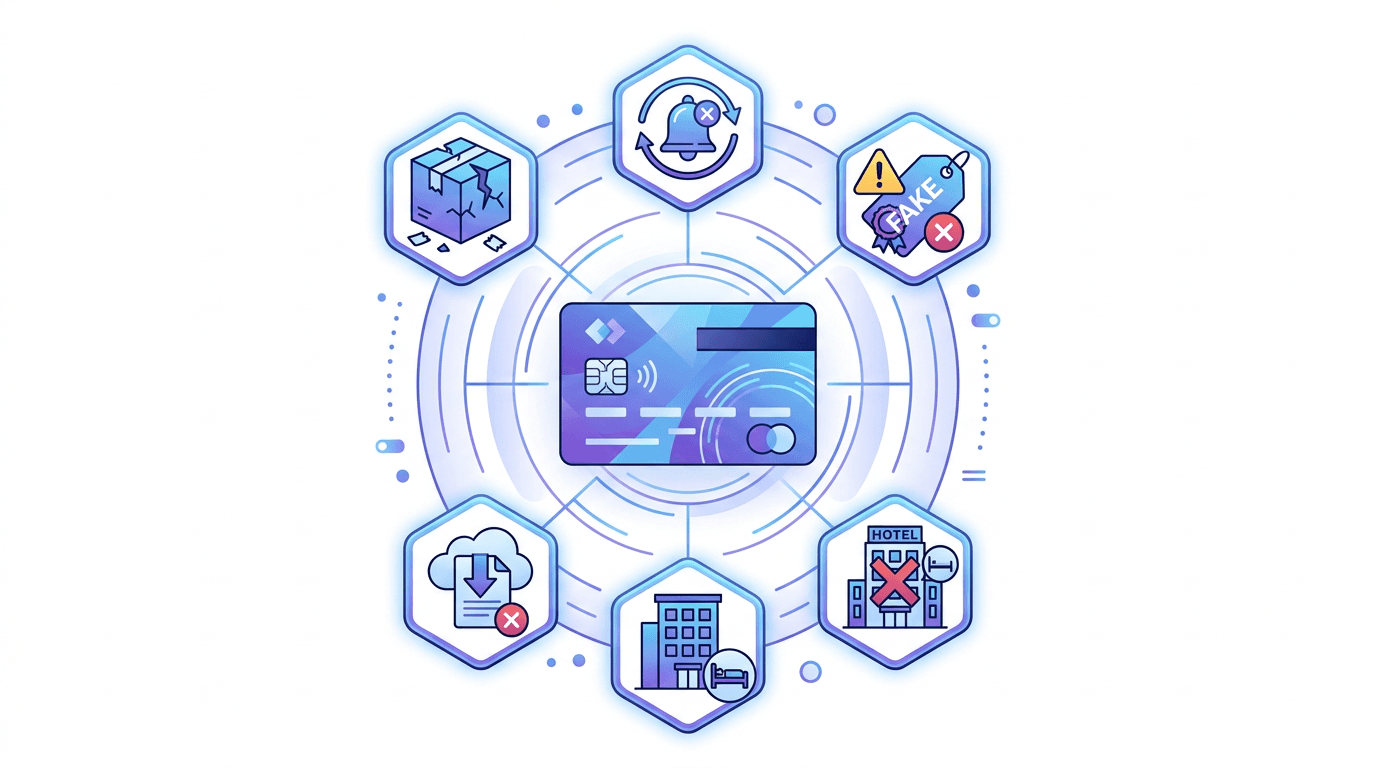
The Swiss Army knife of chargeback codes — covering not received, not as described, cancelled recurring, digital goods, counterfeit, and more. Learn how to identify your sub-type and fight back.
Quick Reference
- Code: 4853
- Category: Cardholder Disputes
- Description: Cardholder Dispute (multiple sub-types)
- Merged Legacy Codes: 4841, 4850, 4855, 4859
- Response Deadline: 45 days from chargeback processing date
- Filing Window: 60-120 calendar days depending on sub-type
- Applies To: All transaction types
Mastercard reason code 4853 is the Swiss Army knife of chargeback codes. It covers practically every non-fraud dispute a cardholder can file — goods not received, goods not as described, cancelled subscriptions, addendum charges, no-show hotel fees, counterfeit merchandise, and more.
What makes 4853 challenging for merchants is that a single code hides many different dispute types, each requiring different evidence to fight. You can't just submit the same response for every 4853 chargeback; you need to identify the specific sub-type first and tailor your defense accordingly.
Over the years, Mastercard has consolidated several older reason codes into 4853, including 4841 (cancelled recurring/digital goods), 4850 (instalment billing disputes), 4855 (goods or services not provided), and 4859 (addendum/no-show/ATM disputes). This means a 4853 chargeback can represent vastly different situations, and the chargeback message text or modifier tells you which one applies.
What Mastercard Reason Code 4853 Actually Means
Code 4853 falls under Mastercard's “Cardholder Disputes” category. Unlike fraud codes where the cardholder says “I didn't make this purchase,” 4853 covers situations where the cardholder acknowledges making the purchase but claims something went wrong with the transaction, the product, or the service.
The cardholder might be saying: “I bought this product and it never arrived.” Or: “I cancelled my subscription but you kept charging me.” Or: “You added a charge I didn't agree to.” Or: “The product I received is counterfeit.” Or: “You charged me a no-show fee but I actually cancelled my reservation.”
The specific claim is communicated through the chargeback's description text and transaction modifier. Before you can effectively respond, you need to identify exactly which sub-type you're dealing with.
Sub-Types of 4853
Here are the main scenarios that fall under 4853, each with different evidence requirements:
Goods or Services Not Received
The customer claims they paid but never received the merchandise or the service wasn't provided. This is Mastercard's equivalent of Visa's 13.1.
Goods or Services Not as Described / Defective
The customer received the product or service but claims it didn't match the description, was defective, or was damaged.
Cancelled Recurring Transaction
The customer claims they cancelled a subscription or recurring payment, but charges continued. Alternatively, the customer claims they never agreed to recurring billing in the first place.
Digital Goods Under $25
Mastercard has specific rules for small digital purchases. If a customer disputes a digital transaction of $25 or less, the merchant must show three specific purchase controls: a default option to disable digital goods purchases, a 15-minute maximum window between entering credentials and completing the purchase, and an explicit transaction amount displayed before confirmation.
Counterfeit Goods
The customer claims the merchandise they received is counterfeit — not the genuine brand or product that was advertised.
Addendum Dispute
An unapproved charge was added to an otherwise-authorized transaction. For example, a restaurant added a tip to the bill that the customer didn't authorize.
No-Show Hotel Charge
The customer was charged a no-show fee for a hotel reservation they claim to have cancelled, or they were not properly informed about the no-show policy.
Timeshare
The customer cancelled a timeshare agreement or similar service and did not receive a credit.

Time Limits
The filing window and response deadlines for 4853 vary by sub-type:
Filing window: The issuer generally has 120 calendar days from the transaction processing date to file the chargeback. For some sub-types, the clock starts from the date the cardholder received the goods, returned them, or first tried to return them.
If the customer returned merchandise or cancelled services, the issuer must wait at least 15 calendar days after the return or cancellation before filing.
Response deadline: You have 45 calendar days from the chargeback processing date to respond.
What Evidence You Need to Win
Because 4853 covers so many scenarios, the evidence requirements vary significantly. Here's what to submit for each major sub-type:
For “Goods/Services Not Received”
- Shipping tracking with delivery confirmation. Carrier records showing the package was delivered to the customer's address.
- Signed delivery receipt if available.
- For services: Work orders, appointment records, or access logs showing the service was provided.
- Customer communication acknowledging receipt or use of the goods/services.
For “Not as Described / Defective”
- Product listing screenshots showing the description and images displayed at the time of purchase.
- Proof the product matched the listing. Photos, specifications, or quality inspection records.
- Communication records showing you offered to resolve the issue (exchange, partial refund) and the customer refused or didn't respond.
- Your return policy and evidence the customer didn't follow the return process.
- Evidence the cardholder has not returned the merchandise.
For “Cancelled Recurring Transaction”
- The original subscription agreement with the customer's opt-in to recurring billing, including timestamps and terms.
- Proof you never received a cancellation request. Check your email logs, support tickets, and cancellation system records.
- Cancellation terms showing how the customer was supposed to cancel and that they didn't follow the process.
- Usage logs showing the customer continued to use the service after the alleged cancellation date.
- Refund documentation if you already issued one.
For “Digital Goods Under $25”
- Screenshots of your purchase controls showing:
- A default option to disable digital goods purchases
- The 15-minute credential-to-purchase window
- Clear display of the total transaction amount before confirmation
- If you can demonstrate all three controls were in place, the chargeback should be reversed.
For “Counterfeit Goods”
- Proof the goods are genuine: Certificates of authenticity, supplier invoices, brand authorization letters, or manufacturing records.
- If the goods are not branded: Evidence that you accurately described the product and never claimed brand affiliation.
For “Addendum Dispute”
- Documentation proving the customer agreed to the additional charge. A signed receipt including the tip amount, a signed work order for additional services, or a booking agreement.
- Transaction records showing the original authorized amount and the final charged amount, with explanation.
For “No-Show Hotel Charge”
- Proof you informed the customer about the no-show policy at the time of booking.
- Evidence the customer met the no-show criteria.
- Booking confirmation showing the no-show terms.
Need help structuring your response? Use our free chargeback response letter template — it includes formats for different dispute types with labeled exhibit references.
How to Structure Your Response
Given the complexity of 4853, your response letter should clearly identify the sub-type before presenting evidence:
Opening: State the case ID, transaction details, and that you are contesting Mastercard reason code 4853. Identify the specific sub-type (goods not received, cancelled recurring, etc.).
Context: One paragraph explaining the transaction — what the customer purchased, when, and the relevant facts.
Exhibits: Organized by relevance to the specific sub-type:
- Exhibit A: The document most directly addressing the claim (delivery proof for “not received,” product listing for “not as described,” subscription agreement for “cancelled recurring”)
- Exhibit B: Supporting documentation
- Exhibit C: Customer communication records
- Exhibit D: Your policies (return policy, cancellation terms, no-show policy)
Closing: Clear request for reversal with a one-sentence summary of why the evidence refutes the cardholder's claim.
For a detailed template, see our Chargeback Response Letter Guide.
Common Mistakes That Lose 4853 Disputes
Not identifying the sub-type. Submitting delivery proof for a “not as described” dispute, or product photos for a “cancelled recurring” dispute. The evidence must match the specific claim.
No policy documentation. For disputes involving returns, cancellations, or no-show charges, you need to show the customer agreed to your policy. If you can't produce it, you'll likely lose.
Missing the digital goods controls. For sub-$25 digital purchases, Mastercard requires three specific purchase controls. If you can't demonstrate all three, the chargeback stands — even if the customer clearly made and used the purchase.
Generic responses. Because 4853 is a catch-all code, some merchants use a generic template. Bank reviewers can tell, and it doesn't address the specific claim.
Not offering resolution before the chargeback. Many 4853 disputes could have been resolved with a partial refund, exchange, or customer service interaction. The bank will look more favorably on the cardholder if there's no evidence you tried to resolve the issue.
How to Prevent 4853 Chargebacks
For “not received” disputes: Ship with full tracking and delivery confirmation on every order. Send proactive shipping notifications. Require signature on high-value orders.
For “not as described” disputes: Use accurate, detailed product descriptions with high-quality photos. Include measurements, materials, and any limitations. Respond quickly to customer complaints and offer exchanges or partial refunds before the issue escalates.
For recurring billing disputes: Send a confirmation email when the subscription starts, clearly stating the recurring nature and billing terms. Send a reminder before each renewal. Provide an easy, self-service cancellation option. Send immediate cancellation confirmation.
For digital goods disputes: Implement all three Mastercard-required purchase controls. Confirm access was granted after purchase. Provide customer support for access issues.
For addendum disputes: Never add charges to a transaction after authorization without the customer's explicit, documented consent.
For no-show charges: Display your no-show policy clearly at the time of booking. Send a reminder email before the reservation date that includes the cancellation deadline and no-show fee.
For all dispute types: Provide responsive, accessible customer service. A customer who can reach you and get a satisfactory resolution will not call their bank.
The Hidden Cost of 4853 Chargebacks
Chargeback fees. Your payment processor charges a fee for every chargeback, typically $15-$25 per dispute. Even if you win the reversal, most processors don't refund this fee.
Operational time. Investigating the dispute, gathering evidence, writing the response letter, and following up takes staff time. For a complex 4853, this can easily consume 2-3 hours of work.
Ratio damage. Every 4853 chargeback counts toward your Mastercard Excessive Chargeback Program ratio, regardless of the outcome. Win or lose, it still hurts your standing.
Lost merchandise. For “not received” or “not as described” sub-types, you often lose both the product and the revenue.
Opportunity cost. Time spent fighting chargebacks is time not spent growing your business. A single 4853 dispute over a $50 order can cost you $100+ in fees, staff time, and lost productivity.
This is why prevention is so critical. For most merchants, it's cheaper to issue a proactive refund to an unhappy customer than to fight a chargeback and risk losing anyway.
When to Fight vs. When to Accept
Fight when: You have clear evidence that contradicts the customer's specific claim — delivery proof for “not received,” product listing accuracy for “not as described,” subscription agreement for “cancelled recurring.” Your evidence is organized and the transaction amount justifies the time investment.
Accept when: The customer's claim has merit, or the transaction amount is so small that the cost of fighting exceeds the potential recovery, or you lack the evidence needed for the specific sub-type.
Refund proactively when: A customer contacts you with a complaint that could easily escalate to a chargeback. A $30 refund is far cheaper than a $30 chargeback with a $20 fee, 2 hours of staff time, and a hit to your chargeback ratio.
For a comprehensive evidence checklist, see our Chargeback Evidence Guide.
Related Reason Codes
Equivalent codes on other networks:
- Visa 13.1 — Merchandise/Services Not Received
- Visa 13.3 — Not As Described or Defective
- Visa 13.7 — Cancelled Merchandise/Services
- American Express C08 — Goods/Services Not Received
- American Express C31 — Goods/Services Not as Described
- Discover NF / RG / RM — Non-Receipt / Quality Disputes
Within Mastercard's system:
- Mastercard 4837 — No Cardholder Authorization (fraud, not a service/quality dispute)
- Mastercard 4834 — Point of Interaction Error
- Mastercard 4860 — Credit Not Processed
FAQ
Why does one reason code cover so many different dispute types?
Mastercard consolidated several older codes (4841, 4850, 4855, 4859) into 4853 to simplify its dispute system. The sub-type is communicated through the chargeback description text and transaction modifiers. This means you need to read the full chargeback details, not just the reason code number, to understand what you're fighting.
The customer says the product is “not as described” but it matches my listing exactly. Can I win?
Yes, if you can show the product matched your description. Provide product listing screenshots (with timestamps if possible), product photos, and specifications. If the customer's complaint is about subjective quality rather than an objective discrepancy, note this in your response. Also provide evidence that the customer didn't attempt to return the product or contact you to resolve the issue.
My digital goods purchase controls meet two out of three Mastercard requirements. Is that enough?
No. For sub-$25 digital goods disputes, Mastercard requires all three controls: a default-off option for digital purchases, a 15-minute credential-to-purchase window, and an explicit total display before confirmation. Missing even one gives the cardholder grounds for a valid dispute. Audit your checkout flow to ensure all three are implemented.
The customer cancelled their subscription but had already used the service for the current billing period. Do I owe a refund?
It depends on your subscription terms. If your terms clearly state that cancellation takes effect at the end of the current billing cycle and the customer agreed to this, you can defend the charge. Provide the subscription agreement, the cancellation timestamp, and usage logs showing the customer continued to access the service during the disputed period.
How do 4853 chargebacks affect my chargeback ratio?
Every 4853 chargeback counts toward your ratio in Mastercard's Excessive Chargeback Program, regardless of the sub-type or outcome. Keeping your ratio below the threshold is critical — exceeding it triggers additional fees, mandatory remediation plans, and potential loss of Mastercard acceptance privileges. Prevention is always more cost-effective than fighting.
Ready to fight your Mastercard 4853 chargeback?
Upload your transaction details and evidence, and ChargebackWin's AI will identify your specific sub-type and generate a targeted response letter with the right evidence for your case.
Fight This Chargeback →Ready to Fight Your Chargeback?
Upload your evidence and get a professional response letter in under 60 seconds. Our AI analyzes your case and generates a dispute-specific rebuttal.
Fight My Chargeback