Chargeback Evidence Guide: What to Submit for Every Dispute Type
The exact documents, screenshots, and records you need to fight each type of chargeback dispute — organized by reason code category, with formatting rules and an evidence-sourcing checklist.
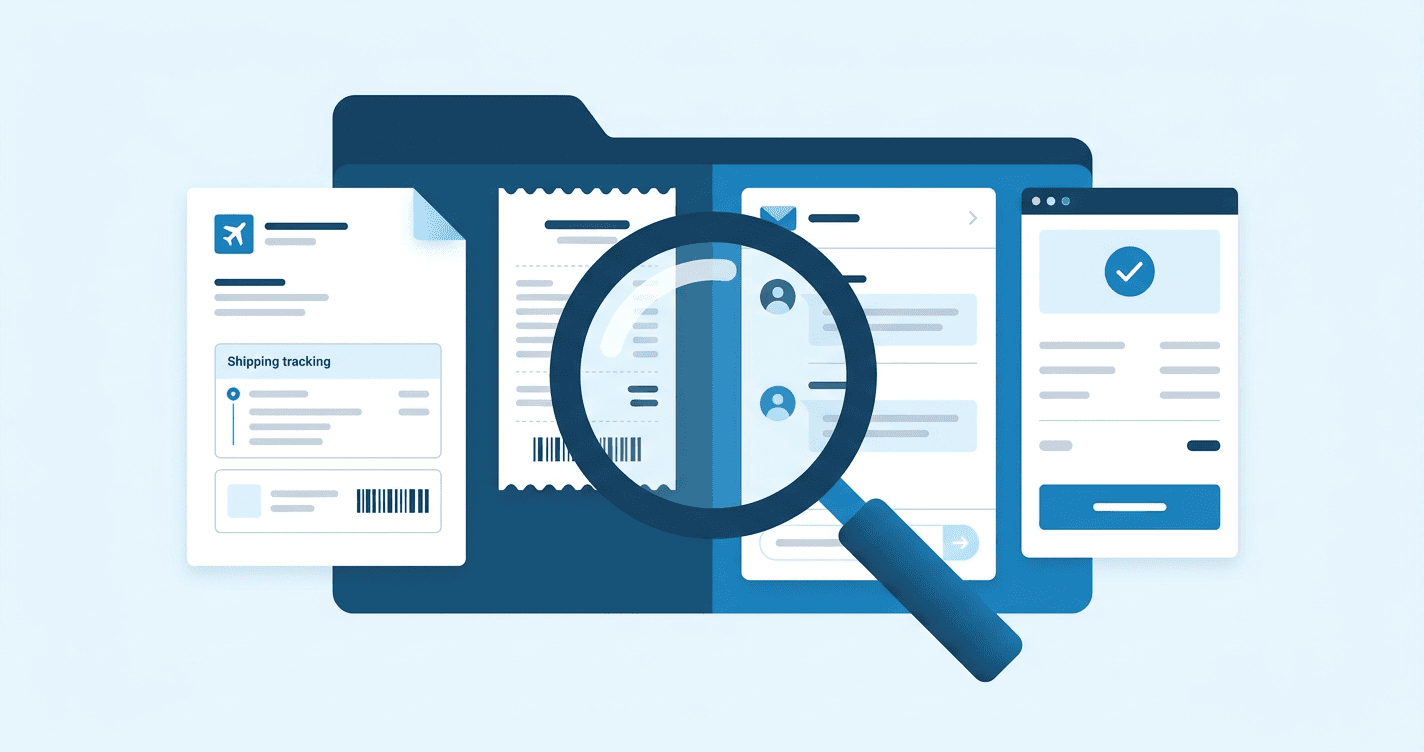
Evidence is the core of every chargeback dispute. You can write a polished response letter, nail every deadline, and still lose — if you submit the wrong documents.
Here's the problem most merchants face: the “right” evidence is completely different depending on the dispute type. A signed delivery confirmation is essential for an “item not received” claim but almost irrelevant for a fraud dispute. An AVS match record is critical for fraud but useless for a subscription cancellation dispute.
This guide eliminates the guesswork. For every major dispute category, you'll find the exact evidence you need to collect, where to find it in your systems, and how to format it so the issuing bank's analyst can actually read it. If you've ever stared at a chargeback notification and thought “what exactly do I need to submit here?” — this is your playbook.
Is It Worth Fighting a Chargeback?
Before you spend time gathering evidence, let's address the question on every merchant's mind: is fighting this chargeback actually worth it?
Here's a simple framework. Every chargeback you receive comes with a fee from your processor — typically somewhere between $15 and $100, depending on your payment provider. That fee is gone whether you fight or not. The question is whether the disputed transaction amount justifies the time you'll invest in building a response.
Fight if: Transaction Amount > (Chargeback Fee + Your Time Cost)
For a $200 dispute, even 2 hours of preparation time is almost certainly worthwhile. For a $15 dispute with a $25 processor fee, it probably isn't.
Now for the win rates. The average chargeback win rate that merchants see is roughly in the range of 30%, though this number fluctuates based on many factors — the dispute type, the card network, the quality of your evidence, and the industry you're in. Merchants who submit professionally organized evidence packages with reason-code-specific documentation tend to win at significantly higher rates than those who send incomplete or generic responses.
But the math goes deeper than any single dispute. There's a hidden cost to not fighting: every chargeback you accept pushes your chargeback rate higher. Once that rate crosses your card network's monitoring threshold (typically around 0.9% for Visa and 1% for Mastercard), you enter a monitoring program that comes with additional fees, mandatory audits, and — in the worst case — the loss of your ability to process card payments entirely.
Bottom line: If the transaction amount is meaningful and you have even a few pieces of solid evidence, fight it. The cost of not fighting compounds over time in ways that go well beyond the individual dispute.
What Is Compelling Evidence?
In the chargeback representment process, “compelling evidence” has a specific meaning: it's documentation that directly contradicts the cardholder's claim. Not vaguely related documents. Not your entire order history. Evidence that speaks to the specific reason this particular chargeback was filed.
This is where most merchants go wrong. They dump everything they have — every email, every screenshot, every system log — into a response package and hope something sticks. This approach backfires. Remember that a real person at the issuing bank reviews your case. If they receive a 30-page document stuffed with irrelevant information, they won't dig through it looking for the one piece that matters. They'll rule against you.
The principle is straightforward: your evidence must match the reason code. If a cardholder claims the transaction was fraudulent, your evidence needs to prove they authorized it — through identity verification records, device data, or prior purchase history. If they claim the product never arrived, your evidence needs to prove it was delivered. Submitting delivery proof for a fraud dispute, or fraud verification records for a non-delivery claim, is a waste of everyone's time.
Quality over quantity — always. Three highly relevant pieces of evidence that directly address the reason code will outperform ten loosely related screenshots every time. Be selective. Be precise. And label everything so the reviewer knows exactly what they're looking at.
Evidence Checklist by Dispute Type
Below is a checklist for each major dispute category. Not every item on the list will apply to every transaction — but the more of these you can provide, the stronger your case. Items marked Critical are the ones you should prioritize first.
Fraud Disputes (Unauthorized Transaction)
The cardholder claims they didn't authorize the transaction. Your job is to prove they did — or that the transaction matches their identity and behavior.
- AVS (Address Verification System) match results — Critical — Shows the billing address entered at checkout matched the address on file with the card issuer.
- CVV/CVC verification results — Critical — Proves the person entering the card details had the physical card (or at minimum, the security code).
- 3D Secure authentication records — Critical — If the transaction passed 3D Secure (Verified by Visa, Mastercard Identity Check), this is strong evidence — it shifts liability to the issuer in many cases.
- IP address and geolocation data — Show the purchase IP matches the cardholder's known location or billing address region.
- Device fingerprint / device ID — Links the transaction to a specific device — especially powerful if the same device was used for prior non-disputed purchases.
- Customer account login history — If the customer logged into an existing account to make the purchase, show the login trail.
- Previous non-disputed transactions from same customer, device, or IP (Visa CE 3.0) — Under Visa's Compelling Evidence 3.0 rules, showing prior successful transactions from the same payment credentials with matching IP address or device ID is one of the strongest forms of evidence available.
- Signed delivery receipt — If physical goods were shipped, proof that the item was delivered to the cardholder's address — ideally with signature confirmation.
Product Not Received
The cardholder says the product never arrived. Your evidence needs to prove delivery — and ideally, delivery to the correct address.
- Shipping carrier name and tracking number — Critical — The foundation of any non-delivery dispute. Without this, you have almost no case.
- Delivery confirmation with full address — Critical — The carrier's confirmation showing the package was delivered, including the destination address.
- Signature confirmation — If available, this is powerful. It directly ties the delivery to a person at the address.
- Shipping notification email sent to customer — Shows you communicated tracking information proactively. Screenshot the email with timestamp.
- Proof of delivery to AVS-matched address — Critical — If the delivery address matches the billing address verified by AVS, this makes the case much stronger.
- Customer communication acknowledging shipment — Any message from the customer confirming receipt, asking about the order after delivery, or discussing the product post-delivery.
- For digital goods: download/access logs with timestamps — Show the customer accessed or downloaded the product, including IP address, device info, and times of access.
Product Not As Described / Defective
The cardholder says the product doesn't match what was advertised or is defective. You need to show what was promised, what was delivered, and that the customer didn't follow your return process.
- Product listing / description page — Critical — Screenshot of the product page the customer saw, including URL and date. If your page has changed since the purchase, use the Wayback Machine to retrieve the version the customer saw.
- Product photos (what was actually sent) — Critical — Photos of the actual item shipped — ideally from your fulfillment process or quality control step.
- Customer communication prior to dispute — Any emails, chats, or messages exchanged before the chargeback was filed. Especially valuable if the customer expressed satisfaction or didn't raise complaints.
- Refund / return policy as shown to customer — Critical — Screenshot showing your return policy was visible during checkout or on your site. Proves the customer had an alternative to filing a chargeback.
- Evidence that customer didn't use your return process — Show that no return request was submitted, no RMA was opened, or no contact was made through your support channels before the dispute.
- Quality control records — If applicable — inspection records, batch testing results, or third-party certification for the specific item.
Duplicate Transaction
The cardholder says they were charged twice for the same thing. You need to show that each charge was for a separate, legitimate purchase.
- Transaction IDs showing separate purchases — Critical — Distinct transaction IDs with different timestamps proving these are two independent orders.
- Itemized receipts for each transaction — Critical — Show that the items, quantities, or services differed between the two charges.
- Evidence that goods/services differed between transactions — Different shipping addresses, different products, different delivery dates — anything that proves these weren't the same order charged twice.
Subscription / Recurring Billing Canceled
The cardholder says they canceled their subscription but were still charged. You need to prove the subscription was active and the customer was properly notified.
- Terms of service / subscription agreement — Critical — The agreement the customer accepted at signup, showing billing frequency, cancellation terms, and renewal conditions.
- Cancellation policy as shown to customer — Critical — Screenshot of how your cancellation process is presented — proving it was accessible and clear.
- Renewal notification emails — Proof that you sent advance notice before the billing cycle renewed. Include email content and delivery confirmation.
- Evidence of continued service usage after alleged cancellation date — Login records, feature usage logs, or content access after the date the customer claims to have canceled. This directly undermines their claim.
- Cancellation confirmation (if customer did cancel after billing) — If the customer actually did cancel — but after the billing date — show the timeline proving the charge was valid at the time it was processed.
Credit Not Processed
The cardholder says they returned the product or canceled the service but never received a refund. Show that the refund was issued — or that it wasn't owed.
- Refund policy — Critical — Your policy as it was presented to the customer, showing conditions under which refunds are or are not issued.
- Evidence that refund was processed (or why it wasn't due) — Critical — If you issued a refund: transaction records showing the credit. If you didn't: documentation showing why it didn't qualify.
- Customer communication about refund — Any messages where you discussed the refund status, timeline, or denial reason with the customer.
Once you've gathered your evidence, the next step is packaging it into a professional response. A structured cover letter with labeled exhibits makes the difference between evidence that gets reviewed and evidence that gets ignored — start with our Chargeback Response Letter Template.
Evidence Formatting Best Practices
Getting the right evidence is half the battle. Formatting it so the issuing bank's analyst can actually use it is the other half. Many dispute cases are reviewed by people working through large queues — and some banks still process documents via fax-quality systems.
| Element | Best Practice |
|---|---|
| File types | PDF, JPEG, or PNG. PDF is preferred for multi-page exhibits. |
| Resolution | High enough to remain readable when printed in black and white. If you can't read your screenshot on a B&W printout, it's not good enough. |
| Labeling | Every document gets a clear label. Not “screenshot1.jpg” — use “Exhibit A - USPS Delivery Confirmation.” |
| Highlighting | Use arrows, circles, or highlight boxes to call attention to key information. But never alter or obscure the original document content. |
| Organization | Organize exhibits in sequence (A, B, C...) and reference each one in your response letter. Strongest evidence goes first. |
Think of it like a court case. Your response letter is the argument. Your exhibits are the evidence. The exhibit labels are how you connect the two. An analyst who can't find the evidence you're referencing in your letter will not go hunting for it.
Where to Find Your Evidence
Knowing what evidence you need is one thing. Knowing where to pull it from your systems is another. Here's a platform-by-platform guide to locating the most common evidence types.
Shopify
Go to Orders → click the specific order. You'll find the transaction details, fulfillment history, tracking number, and timeline of events. Screenshot each relevant section. Shopify also has a built-in chargeback response flow that auto-populates some evidence.
Stripe
Navigate to Payments → click the specific payment. You'll see the full transaction details including AVS/CVV results, risk assessment, IP address, and payment method details. The Disputes section provides a submission interface.
Shipping Carriers
USPS, FedEx, UPS, DHL — go to the carrier's tracking page and screenshot the full delivery history. Make sure the delivery confirmation, date, and address are all visible in your screenshot.
Email / Support Records
Search your email or help desk (Zendesk, Gorgias, etc.) for all communication with the customer. Screenshot full threads with visible timestamps and email addresses.
Your Website
For product pages, policies, and terms — screenshot the current versions. If your pages have been updated since the transaction, use the Wayback Machine (web.archive.org) to retrieve the version the customer saw at the time of purchase.
Payment Gateway
Your payment gateway (Braintree, Authorize.net, Square, etc.) will have detailed transaction records including verification results, authorization codes, and any 3D Secure authentication data.
Timing matters. Some data has retention limits. Carrier tracking pages may become unavailable after 90-120 days. Email threads can be deleted. Screenshot and save evidence as soon as a dispute arrives — don't wait until you're ready to write the response.
How to Organize Evidence into an Exhibit Package
A pile of evidence is not a case. The difference between winning and losing often comes down to how well you organize your submission. Here's the system that works.
1. Use an exhibit labeling system. Label each piece of evidence as Exhibit A, Exhibit B, Exhibit C, and so on. This creates a clear reference framework that your response letter can point to. When your letter says “As shown in Exhibit B, the package was delivered on March 3rd with signature confirmation,” the reviewer knows exactly where to look.
2. Put your strongest evidence first. Exhibit A should be the single most compelling piece of evidence against the cardholder's claim. If this is a fraud dispute and you have 3D Secure authentication proof, that's Exhibit A. If it's a non-delivery claim and you have a signed delivery receipt, lead with that.
3. Reference every exhibit in your response letter. Every exhibit label should appear at least once in your response letter. If an exhibit isn't referenced in your argument, ask yourself whether it actually strengthens your case — or whether you're including it just to pad the package.
4. Keep the total package focused. A tight package of 4-6 well-chosen, clearly labeled exhibits almost always outperforms a 15-page document dump. The reviewer has limited time. Respect it.
Need help with your response letter? Your evidence package works hand-in-hand with your rebuttal letter. Check out our Response Letter Guide for templates and writing tips that reference your exhibits effectively.
Frequently Asked Questions
How many pieces of evidence do I need to win a chargeback dispute?
There's no magic number, but quality matters far more than quantity. Three to five highly relevant documents that directly address the reason code will typically give you the strongest case. Submitting ten loosely related screenshots often dilutes your argument rather than strengthening it. Focus on the evidence that specifically contradicts the cardholder's claim.
What file format should I submit evidence in?
PDF is generally the safest choice, especially for multi-page exhibits. JPEG and PNG work for individual screenshots. Always check your payment processor's specific requirements — some have preferences or file size limits. And make sure everything is legible when printed in black and white.
What happens if I don't have all the evidence on the checklist?
You don't need every item — the checklists above are comprehensive, and many items are situational. Submit the strongest evidence you do have. A dispute with two or three solid pieces of evidence is still worth fighting if the documents directly address the reason code.
How long do I have to submit my chargeback evidence?
Response deadlines vary by processor and card network, but they're typically in the range of 7 to 30 days from the date you're notified. The exact window will be noted on your chargeback notice. Best practice is to submit at least a few days before the deadline.
Can I highlight or annotate my evidence documents?
Yes — and you should. Use arrows, circles, or highlight boxes to draw attention to the key details (delivery dates, matching addresses, verification codes). Just don't alter, crop out, or obscure any of the original document content. The annotations should guide the reviewer's eye, not change what the document says.
What is Visa Compelling Evidence 3.0?
Visa's CE 3.0 framework specifically addresses fraud disputes. It allows merchants to present evidence of prior non-disputed transactions made with the same payment credentials where at least two of the following match: the customer's IP address, device ID/fingerprint, or shipping address. If you can show that the same card was used successfully (without dispute) in previous transactions from the same device or IP, it significantly strengthens your fraud defense.
Ready to Fight Your Chargeback?
Upload your evidence and get a professional response letter in under 60 seconds. Our AI analyzes your case and generates a dispute-specific rebuttal.
Fight My Chargeback